
Recent Posts
Categories
What is Artificial Intelligence? Beginner's Guide
Introduction
Artificial Intelligence (AI) is becoming one of the most popular technologies in the world. It can complete many tasks quickly and accurately. Whether you want to create text, images, videos, presentations, designs, computer code, or even solve complex problems, AI can do it within seconds or minutes.
A few years ago, creating these things often took hours or even days. Today, you simply enter a prompt, and AI generates the result almost instantly. This saves time, reduces effort, and helps people work more efficiently.
Because AI makes difficult tasks easier, it is now used by students, professionals, businesses, content creators, and many other people around the world.
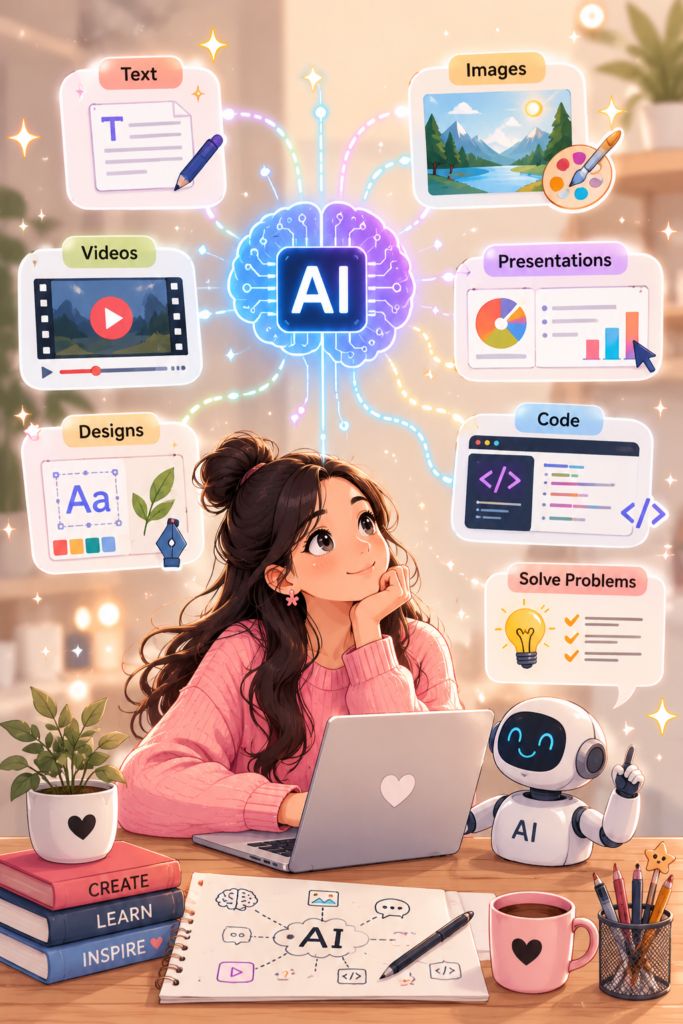
Table of Contents
- What is Artificial Intelligence?
- Why is AI So Popular?
- History of Artificial Intelligence
- How Does AI Work?
- AI vs Machine Learning vs Deep Learning
- Types of Artificial Intelligence
- Popular AI Tools
- Real-Life Examples of AI
- Applications of AI
- Advantages of AI
- Disadvantages of AI
- Is AI Safe?
- How to Start Learning AI
- Common Myths About AI
- Future Scope of AI
- Frequently Asked Questions
- Conclusion
Why is AI So Popular?
Artificial Intelligence has become popular because it can complete many tasks quickly and accurately. Whether you need to write an article, generate images, edit videos, create presentations, design graphics, or write computer code, AI can help you finish the work within minutes.
Previously, these tasks required hours or even days of manual effort. Today, you simply provide a prompt, and AI generates the result almost instantly.
Because AI saves time, reduces effort, improves productivity, and makes difficult tasks easier, it has become one of the fastest-growing technologies in the world.
History of Artificial Intelligence
The idea of Artificial Intelligence began many years ago, but the term Artificial Intelligence was officially introduced in 1956 by American computer scientist John McCarthy during the Dartmouth Conference. He is often called the Father of Artificial Intelligence.
In the early days, AI was mainly used for research because computers were slow and expensive. As technology improved, AI became more powerful and started solving real-world problems. The growth of the internet, cloud computing, and large amounts of digital data helped AI learn faster and perform better.
Today, AI is used in smartphones, hospitals, schools, banks, online shopping, transportation, entertainment, and many other industries. Modern AI tools such as ChatGPT, Gemini, Claude, and Microsoft Copilot have made AI accessible to millions of people around the world.
How Does AI Work?
AI works based on instructions provided by humans. These instructions are called prompts. A prompt can be written as text or spoken using voice commands.
Even if someone writes a simple prompt, AI often understands the request and provides useful results. However, the quality of the output depends on how clearly the prompt is written.
A good prompt usually includes:
- Clear instructions
- Purpose of the task
- Required output format
- Important details
- Preferred tone or writing style
The more detailed and specific your prompt is, the better the AI understands your request and produces accurate results.
AI vs Machine Learning vs Deep Learning
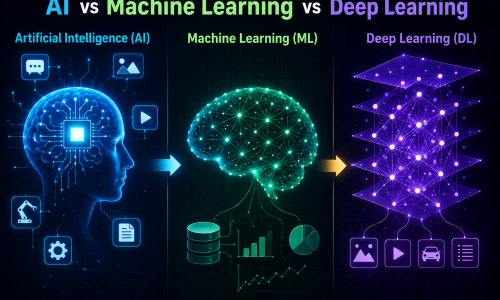
Many people think Artificial Intelligence, Machine Learning, and Deep Learning are the same, but they are different.
Artificial Intelligence (AI) is the broad concept of making machines perform intelligent tasks.
Machine Learning (ML) is a part of AI where computers learn from data instead of being programmed for every task.
Deep Learning (DL) is a more advanced part of Machine Learning. It uses artificial neural networks to solve complex problems such as image recognition, speech recognition, and language understanding.
Simple Example
- AI = A smart robot.
- Machine Learning = The robot learns from experience.
- Deep Learning = The robot learns like the human brain using massive amounts of data.
Types of Artificial Intelligence
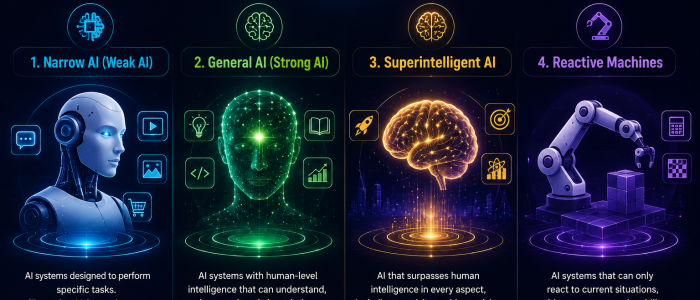
1. Narrow AI (Weak AI)
Narrow AI is designed to perform one specific task. It cannot think beyond its assigned purpose.
Examples:
- ChatGPT
- Google Gemini
- Siri
- Alexa
- Google Translate
- Netflix Recommendations
2. General AI (Strong AI)
General AI is a theoretical form of AI that can think, learn, and solve problems just like humans.
Currently, General AI does not exist.
3. Super AI
Super AI refers to a future form of AI that would become more intelligent than humans in every field.
Currently, Super AI is only a concept and has not been developed.
AI vs Machine Learning vs Deep Learning
Many people think Artificial Intelligence, Machine Learning, and Deep Learning are the same, but they are different.
Artificial Intelligence (AI) is the broad concept of making machines perform intelligent tasks.
Machine Learning (ML) is a part of AI where computers learn from data instead of being programmed for every task.
Deep Learning (DL) is a more advanced part of Machine Learning. It uses artificial neural networks to solve complex problems such as image recognition, speech recognition, and language understanding.
Simple Example
- AI = A smart robot.
- Machine Learning = The robot learns from experience.
- Deep Learning = The robot learns like the human brain using massive amounts of data.
Advantages of AI
- Improves the quality and accuracy of work.
- Saves a significant amount of time.
- Automates repetitive tasks.
- Increases productivity.
- Gives people more time to focus on important work.
- Available 24/7 without getting tired.
- Many AI tools are free or offer free versions.
- Easy to use with simple prompts.
- Used in healthcare, education, banking, agriculture, businesses, and many other industries.
Disadvantages of AI
- Some jobs may be replaced by automation.
- Competition is increasing because AI makes tasks easier.
- People need to learn AI skills to stay competitive.
- AI can sometimes provide incorrect or misleading information.
- Privacy and data security remain important concerns.
- AI cannot replace human creativity, emotions, or critical thinking.
- Overdependence on AI may reduce problem-solving abilities.
Is AI Safe?
AI is used by millions of people every day. Since AI works with data, many users wonder whether their information is safe.
Most trusted AI platforms use security measures to protect user data. However, users should also follow good safety practices.
Never share:
- Passwords
- Banking information
- Credit card details
- Aadhaar or PAN information
- Passport details
- Confidential office documents
- Personal medical records
Always read the privacy policy before using any AI platform and avoid uploading sensitive information unless necessary.
How to Start Learning AI
If you are a beginner, you can start by following these simple steps:
- Learn the basics of Artificial Intelligence.
- Understand how prompts work.
- Practice using ChatGPT and Gemini.
- Learn prompt writing.
- Explore Machine Learning concepts.
- Read AI blogs and watch beginner tutorials.
- Stay updated with new AI technologies.
- Practice using AI every day.
Common Myths About AI
AI will replace every job.
AI will automate some tasks, but many jobs will continue to require human creativity and decision-making.
AI always gives correct answers.
AI can make mistakes, so always verify important information.
AI can think like humans.
AI processes data and patterns. It does not have emotions or consciousness.
AI is only for programmers.
Anyone can use AI, including students, teachers, business owners, designers, writers, and professionals.
Future Scope of AI
Artificial Intelligence is expected to grow rapidly in the coming years.
Future applications include:
- Smarter healthcare
- Personalized education
- Self-driving vehicles
- Advanced robotics
- Scientific research
- Better cybersecurity
- Smart cities
- Agriculture automation
- Business automation
- Personal AI assistants
Learning AI today can help prepare individuals for future careers and technological advancements.
Artificial Intelligence is technology that enables machines to perform tasks that normally require human intelligence.
Many AI tools offer free plans, while advanced features may require a subscription.
Yes. ChatGPT is an AI chatbot developed by OpenAI.
AI can automate repetitive tasks but cannot completely replace human creativity, emotions, and critical thinking.
Yes, when used responsibly. Avoid sharing sensitive personal or financial information.